Sasha Rayshubskiy
Harvard
ICRA workshop
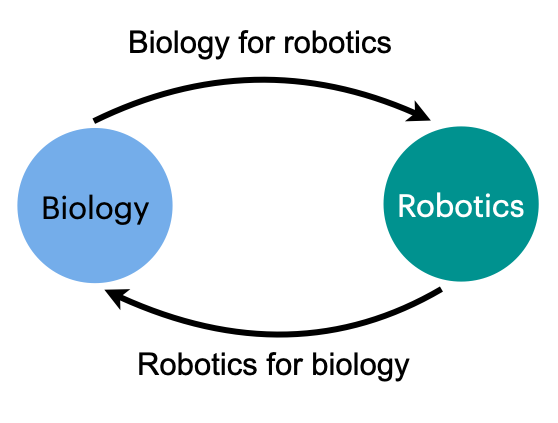
Over half a billion years of evolution, animals evolved remarkable adaptations for locomotion in complex three-dimensional environments. For centuries, engineers have turned to these biological systems to seek inspiration for constructing functional, flexible, and efficient robotics. In the past decades, biologically inspired robotics has matured into a significant branch of robotics. Recently, biologists and interdisciplinary teams are using robots as viable testbeds to explore and evaluate hypotheses in animal behavior. This strategy offers a suitable alternative to traditional biological methods, which have several limitations, including the feasibility to minimize confounding influences and isolate effects, the effects of the experiment and the experimenter on the study animal, and other limitations imposed by the behavior of the animals, etc. This workshop aims to bringing latest results in bio-inspired robots and expand their applications in biological studies from individual locomotion to collective behavior. Current studies on bio-inspired robots are evolving due to a deeper understanding of biological principles. In return, these bio-inspired robotics are providing the perfect platform for biologists to better understand biological phenomena.
Harvard

NUS

EPFL

University of Michigan

EPFL

University of Konstanz

Tsinghua University

MIT

Beihang University
Empa

Peking University

Max Planck Institute of Animal Behavior

University of Bristol
Zhejiang University

Nanjing University of Aeronautics and Astronautics

Westlake University

Stanford University
| Time | Activity | Speaker | Title | Chair |
|---|---|---|---|---|
| 08:20 - 08:30 | Opening | |||
| 08:30 - 09:00 | A Symbiotic Philosophy for Bio-Inspired Robotics | Talia Moore | Steven Ceron | |
| 09:00 - 09:30 | Swarm Robotics Inspired by Collective Cell Migration | Shuguang Li | ||
| 09:30 - 10:00 | The Fruit Fly, Drosophila Melanogaster, as a Micro-robotics Platform | Sasha Rayshubskiy | ||
| 10:00 - 10:30 | Coffee Break (Poster Session 1) | |||
| 10:30 - 11:00 | From Marine Species to Soft Robotics, and Back: the Case of Soft Benthic Robots | Cecilia Laschi | Heiko Hamann | |
| 11:00 - 11:30 | Perching Like a Hawk: What Avian-informed Drones can Tell us about Avian Flight Manoeuvres | Dario Floreano | ||
| 11:30 - 12:00 | Octopus-inspired Sensorized Soft Arm for Environmental Interaction | Li Wen | ||
| 12:00 - 12:10 | From Schooling Pufferfish in Nature to Swimming Pufferfish Robots and Back: Lateral Lines-Based Location and Orientation Perceptions Among Schooling Fish | Xingwen Zheng | Liang Li | |
| 12:10 - 12:20 | Biomimetic on Gecko Locomotion: from Biology to Application | Zhendong Dai | ||
| 12:20 - 12:30 | Sea Guru-I, the Bio-Inspired Deep-Sea Robot From Laboratory Tests to Dives at 2000m | Dixia Fan | ||
| 12:30 - 13:30 | Lunch Break | |||
| 13:30 - 14:00 | Soft PaleoRobotics - Tail Fin Shape Change for Pitch Control During Swimming | Ardian Jusufi | Andreagiovanni Reina | |
| 14:00 - 14:30 | TBD | Guangming Xie | ||
| 14:30 - 15:00 | Investigating Animal Locomotion Using Biorobots and Neuromechanical Simulations | Auke Ijspeert | ||
| 15:00 - 15:30 | Coffee Break (Poster Session 2) | |||
| 15:30 - 16:00 | Musculoskeletal Biohybrid Robots: From Swimmers to Legged Creatures | Robert Katzschmann | Wei Wang | |
| 16:00 - 16:30 | Agile and Robust Micro-aerial-robot Powered by Soft Artificial Muscles | Kevin Chen | ||
| 16:30 - 16:40 | Investigating the Coevolution of Cooperative Swimming with Robotic Fish | Maya Dagher | Jonas Kuckling | |
| 16:40 - 16:50 | Dexterous Biomimetic Tactile Robots | Nathan Lepora | ||
| 16:50 - 17:00 | TadBot: A Tadpole-Mimic Robot for Studying Poison Frog Parental Investment | Tony G. Chen | ||
| 17:00 - 17:20 | Closing & Award |

MPI-AB & University of Konstanz

University of Wisconsin-Madison
Massachusetts Institute of Technology

Massachusetts Institute of Technology
University of Konstanz

University of Konstanz

MPI-AB

University of Konstanz